
English is already part of your everyday life. You listen to music, watch films and TV series, read articles online, or use it at work from time to time. No doubt you know quite a lot already – but when it comes to speaking, something holds you back.

You worry about making mistakes. You search for the „perfect” sentence before saying anything at all. And instead of speaking, you stay silent.

Does that sound familiar?

You’ve probably tried learning English before. Maybe you’ve taken language courses, studied with apps, or worked through textbooks on your own. You may have learned plenty of grammar and memorised long lists of vocabulary, but you still don’t feel comfortable having a real conversation in English.

The truth is, speaking with confidence doesn’t come from knowing more grammar rules.

It grows when you have regular conversations, talk about things that genuinely interest you, and learn in an environment where making mistakes is simply part of the process—not something of which to be afraid.

I know this because I’ve seen it time and time again.

Like you, I live in Brussels. For many here, the opportunities to develop their English are limited, because the Belgian education system naturally focuses on the country’s official languages first. I know that large group courses also pose a problem, insofar as everyone learns differently. People come with different goals, different strengths, and different challenges. In a class of 14 or 20 students, it’s almost impossible to give everyone the support they really need.

That’s why I decided to create something different.

I’ve developed a teaching approach that helps even the quietest and most hesitant learners start speaking English naturally and with confidence. My lessons are practical, supportive, and tailored to the people in front of me. There is no pressure to be perfect—only encouragement to communicate.

I’m a qualified philologist, but I don’t teach English in the traditional way. My focus isn’t on helping you pass a test—it’s on helping you use English in real life. That’s why my students often surprise themselves with how quickly they gain confidence.
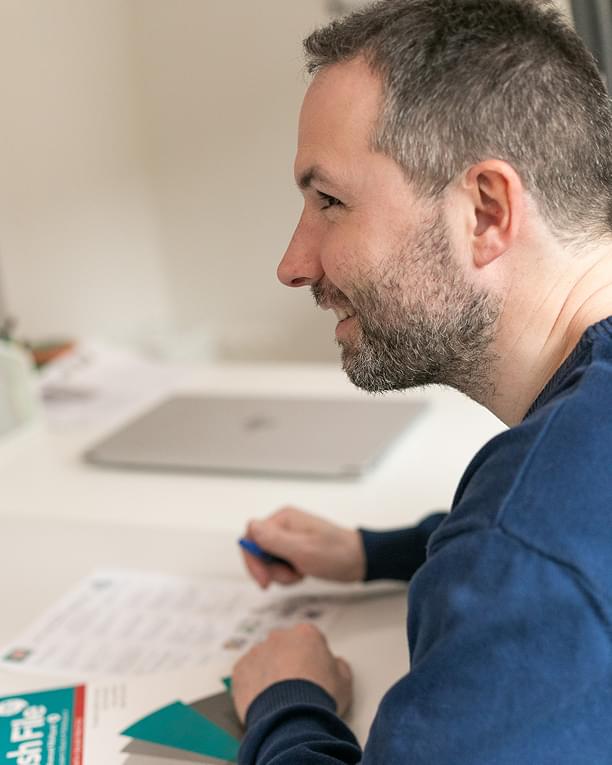

Small Groups of No More Than 6 Students

Learning is simply more enjoyable in a small group. The atmosphere feels relaxed and friendly—more like meeting a group of familiar faces than sitting in a traditional classroom. As your confidence grows, speaking English becomes much more natural.

With a maximum of six students, everyone has plenty of opportunities to speak. You’ll practise new grammar and vocabulary in situations that reflect real life: chatting while shopping, talking to international clients, preparing for a job interview, or handling everyday conversations with confidence.

Small groups also mean there’s always time to ask questions, clear up any doubts, and receive individual feedback. Lessons move at the pace of the group—not too fast, not too slow—so everyone has the chance to understand, practise, and make steady progress.

Grammar That Helps You Communicate

You don’t need to know every grammar rule to become a confident English speaker. Just think about how children learn their first language—they start by communicating, not by studying grammar.

At the same time, I know that adult learners often want to understand why English works the way it does. That’s why I explain grammar clearly and simply, without unnecessary jargon. Once the concept makes sense, we immediately put it into practice through meaningful conversations and realistic situations—not scripted dialogues that you’ll never use outside the classroom.

The goal isn’t to memorise rules. It’s to use them naturally when you speak.

Courses Designed for Polish Speakers

Over the years, I’ve met many Polish learners who felt frustrated because grammar had never really been explained in a way that made sense to them. They had memorised rules without fully understanding how or when to use them.

That’s why I also offer courses designed specifically for Polish speakers. I explain English grammar by drawing clear comparisons with Polish whenever it helps. Instead of asking you to memorise rules, I help you understand the logic behind them.

Once everything starts to make sense, speaking becomes much easier. My students no longer wonder „Is this correct?” every time they open their mouths. Instead, they speak with growing confidence, knowing not only what to say, but why they are saying it that way.

Real Conversations, Not Scripted Role-Plays

The best way to learn to speak is… by talking.

Depending on the group’s level, we discuss everyday life, work, travel, current affairs, personal experiences, and topics that genuinely interest us. We recommend books and films, talk about inspiring people, exchange views, and sometimes even debate what’s happening in the world—all in English.

Thanks to the relaxed and supportive learning environment, even students who once felt terrified of speaking gradually become confident communicators. Everyone is learning together, nobody is judged, and mistakes are simply part of the learning process.

Content and Language Integrated Learning (CLIL)

Language is much easier to remember when it’s connected to something genuinely interesting.

At Green Door, we explore engaging topics about remarkable people, history, science, art, culture, geography, nature, and sometimes even current affairs. All materials are carefully adapted to the language level of the group, so they’re both accessible and stimulating.

This approach, known as CLIL (Content and Language Integrated Learning), allows you to improve your English while discovering new ideas and expanding your knowledge at the same time.

Learning becomes something you look forward to, not something you have to do.

Contact

Contact me today and start learning English.

Go to Contact